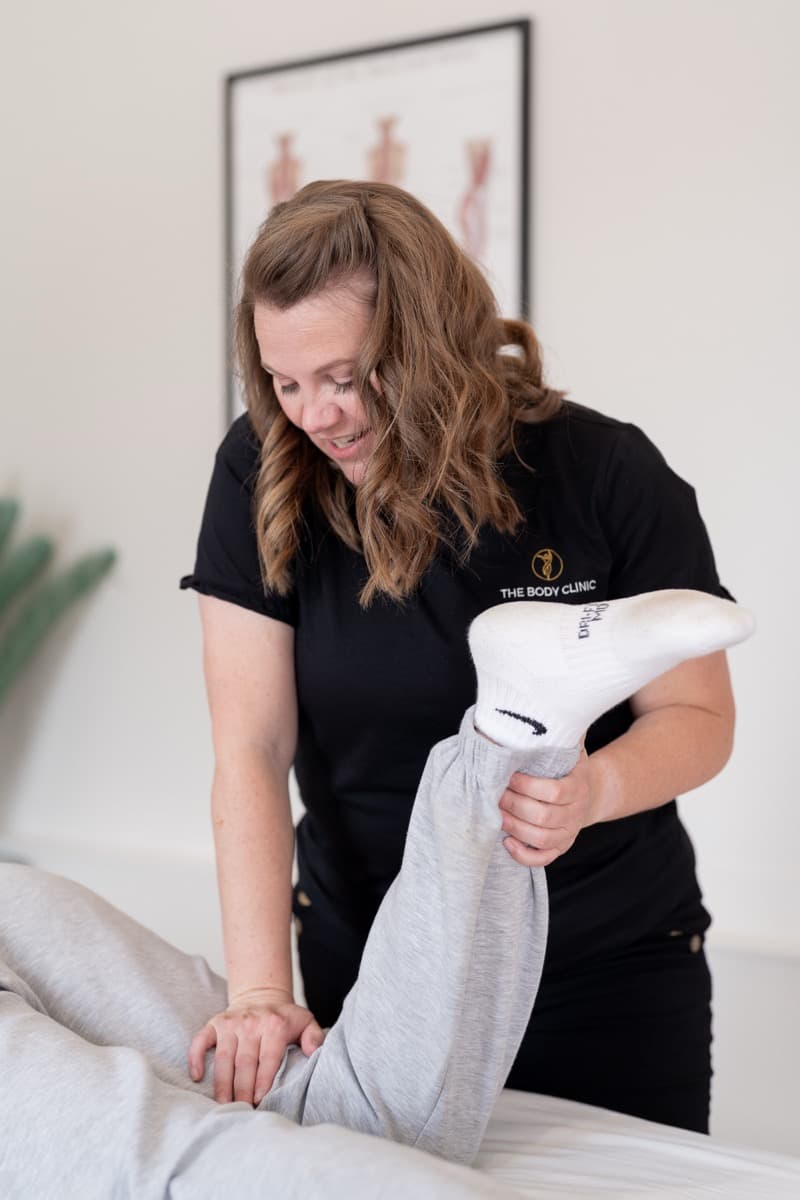
A simple guide to the corrective massage work behind The Body Clinic.
If you've ever had a knee that ached and been surprised when your therapist spent the first twenty minutes nowhere near your knee — this is for you. That's the Berry Method, and once you understand the idea behind it, it makes complete sense.
Here's the whole thing in one sentence: your body is a structure held in balance, and most pain is a sign that the balance is off somewhere — often far from where it hurts.
Think of your body like a tent
Picture a tent held up by ropes staked into the ground. The poles are your bones. The canvas is your skin and muscle. But what actually holds the shape — what keeps everything standing straight — are the ropes.
In your body, those ropes are your connective tissue (also called fascia): a continuous, slightly stretchy web that wraps every muscle and links bone to bone, head to toe.
Now imagine one rope shrinks — maybe years ago you took a hard fall, or you've sat hunched at a desk for a decade. That one tight rope pulls the whole tent slightly out of square. The canvas looks fine. Nothing's "torn." But the tent is leaning, and over time the strain shows up somewhere else entirely: a shoulder that sits higher than the other, a hip that never feels level, a knee that takes the load it was never meant to carry.
You can't fix a leaning tent by pushing on the saggy wall. You have to find the tight rope and let it back out. That's what the Berry Method does.
Where it comes from
The Berry Method documents the life's work of Lauren E. Berry, a registered physical therapist whose hands-on approach was written down and turned into a teaching manual in 1981. Its roots trace back to traditional Scandinavian massage, and it's described as corrective work — the goal isn't just to feel good for an hour, it's to gently correct the mechanical imbalances underneath.
Why we don't chase the spot that hurts
This is the part that surprises people most. In the Berry Method, the place that hurts is usually the messenger, not the message.
Pain is your body telling you something is under strain. But the strain is often a compensation — your body bracing and pulling in one area to make up for a restriction somewhere else. Massage only the sore spot and you're arguing with the messenger while the real cause keeps sending it.
So the work follows the body's logic instead:
- Balance the whole frame first. The session works the connective tissue around the spine and trunk before zeroing in on a single joint. A healthy spine and open trunk mean better blood flow and clearer nerve signals everywhere downstream.
- Then address the specific area — the knee, the shoulder, the jaw — once the structure around it is no longer fighting itself.
It doesn't "heal" you — and that's the point
One of the most honest ideas in this work: a massage doesn't heal your body. Your body heals itself. What this method does is remove the mechanical roadblocks — the shortened tissue, the stuck joint, the restricted range of motion — so your body can do its own repair work efficiently, the way it's designed to.
Gentle, precise, working with your natural range of motion rather than forcing anything — it's about giving the system room to rebalance, not overpowering it.
Why no two sessions feel identical
There's a set of foundational movements that nearly everyone receives — but how they're applied is completely individual. As the original manual puts it, treating an iron worker is nothing like treating a ballerina. Your build, your history, your daily strain, the way your tissue responds — all of it shapes the session. The framework is consistent; the hands adapt to you.
Who it tends to help
People come to this work for:
- Nagging aches that "imaging says are fine" but never fully settle
- Old injuries that quietly changed how they stand, sit, or move
- Tension that keeps coming back to the same spot no matter how much it's rubbed
- A body that just feels off-balance — one side tighter, one shoulder higher
Curious whether the Berry Method is right for you? Book a session with Nikki at The Body Clinic — and feel what it's like to have the whole structure addressed, not just the part that's shouting.