Here's something most people don't think about: every scar on your body is doing more than just sitting there looking tough. It's pulling on surrounding tissue, disrupting nerve signals, restricting movement, and potentially causing pain in places you'd never connect to it.
That C-section scar? It might be why your lower back won't stop aching. That old surgery scar on your knee? It could be affecting your hip mobility. Scars are like knots in a spider web — tug on one strand and the whole structure shifts.
The good news? There's a technology that's changing how we treat scar tissue, and it fits in the palm of your hand. Meet the Dolphin Neurostim.
What Is the Dolphin Neurostim?
The Dolphin Neurostim is an FDA-cleared, Health Canada-licensed medical device developed by the Center for Pain and Stress Research (CPSR) over nearly a decade of research. It looks like a pen, weighs almost nothing, and delivers something called Microcurrent Point Stimulation (MPS) — a form of direct current (DC) microcurrent at incredibly low levels.
How low? We're talking less than 1 milliamp — that's 98-99% less electrical output than a standard TENS unit. If a TENS machine is a fire hose, the Dolphin is a garden mister. But that gentleness is exactly what makes it work.
The Science: Why Less Is More
This is where it gets fascinating.
In 1982, researcher Nordenström Cheng and colleagues published a landmark study in Clinical Orthopaedics and Related Research that changed our understanding of how electricity affects living tissue. They found that direct electrical currents between 10 and 500 microamperes:
- Increased ATP production (cellular energy) by up to 500%
- Boosted protein synthesis by 70%
- Significantly increased amino acid uptake
The pioneering work of Dr. Robert O. Becker, author of The Body Electric (1985), further demonstrated that living organisms generate measurable DC electrical currents and that wound healing is regulated by electrical potentials at the cellular level. His research showed that applying negative electrical potential at wound sites could actually stimulate tissue regeneration.
The Dolphin Neurostim builds on this foundation. It delivers DC microcurrent at 2.4-3.0 Hz — a frequency range that matches the body's own bioelectrical signaling — to restart healing processes that scar tissue has disrupted.
How Scar Tissue Causes Problems You'd Never Suspect
To understand why the Dolphin works, you need to understand why scars are more than skin deep.
When your body heals from a cut, surgery, or burn, it lays down collagen fibers in a rushed, disorganized pattern — like a road crew throwing down patches as fast as possible without worrying about alignment. The result is functional but messy. This scar tissue is:
- Denser and less elastic than healthy tissue
- Higher in electrical resistance — sometimes many times that of normal skin
- Poorly hydrated compared to surrounding tissue
- Adhesive — it sticks to layers of tissue that should glide freely over each other
This is why a C-section scar can contribute to back pain. Why an old appendectomy scar can affect hip mobility. Why a mastectomy scar can cause shoulder restriction years later. The scar is pulling on the fascial web, and the effects radiate outward.
What MPS Scar Release Actually Does
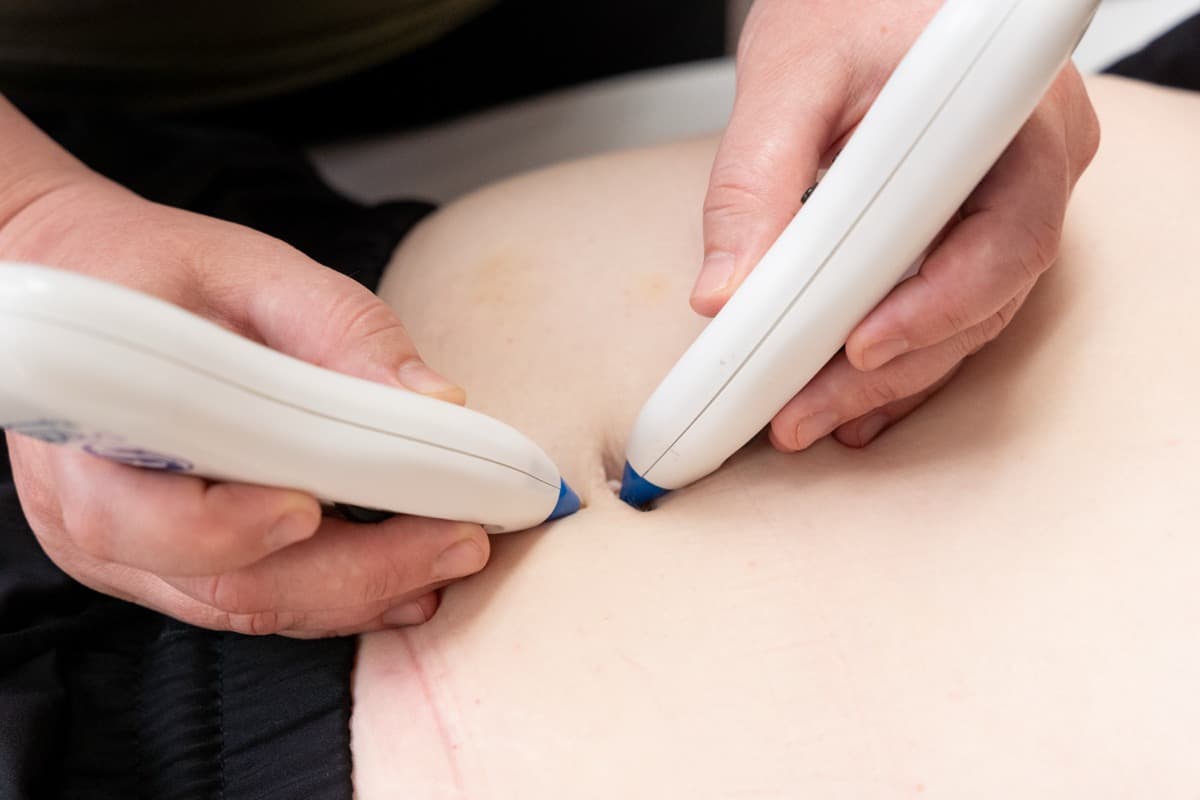
The treatment uses two Dolphin Neurostim devices simultaneously, placed on opposite sides of the scar with different polarity settings. Here's what happens:
Electrical Repolarization — Scar tissue carries a positive electrical charge, while healthy tissue is negatively charged. By driving negatively charged microcurrent through the positively charged scar, the Dolphin helps normalize the tissue's electrical potential. Practitioners report that this change is sometimes visible immediately — the scar tissue softens and changes color during treatment.
Fascial Release — The microcurrent relaxes the tight, contracted scar tissue, releasing adhesions between tissue layers. Structures that were stuck together begin to glide again.
Cellular Reactivation — By boosting ATP production and protein synthesis at the cellular level, MPS essentially wakes up the tissue's self-repair mechanisms. Circulation increases to the area, the lymphatic system begins clearing dead cells, and new, healthier tissue can form.
Pain Reduction — MPS down-regulates the sympathetic nervous system (your fight-or-flight response) and stimulates the production of beta-endorphins — your body's natural painkillers. This isn't masking pain; it's addressing the neurological mechanisms that create it.
Source: US Patent 9968773B1: Method and System for Rehabilitation of Scar Tissue
What the Research Shows
Multiple published studies have examined MPS therapy for scar-related pain:
Chronic Pain and Scars (2017): A study of 51 patients with chronic pain and physical scars found that MPS produced a 59% pain reduction immediately after treatment and an additional 34% reduction at the 48-hour follow-up — a total pain reduction of 73.2% (p=0.0001).
C-Section Scars (2019): A study of 47 women with chronic pain averaging 8.6 years in duration found that MPS applied to C-section scars produced a 67.5% pain reduction post-treatment and an additional 45.2% at the 48-hour follow-up — a total pain reduction of 82.2% (p=0.000).
MPS Combined with Massage (2018): A comparison study of 98 patients found that massage combined with MPS achieved a 78% total pain reduction at 48-hour follow-up — significantly outperforming massage alone.
Source: Armstrong, K. et al. Journal of Yoga and Physiotherapy, 2018
Neck Pain (2017): A study published in the Journal of Alternative and Complementary Medicine found an 80% improvement in neck pain with MPS treatment.
Source: PMC/PubMed, 2017
A note on transparency: These studies are published in peer-reviewed journals and show promising results, but they are primarily cohort studies with moderate sample sizes. The research was also conducted by investigators connected to the device manufacturer. Larger, independent randomized controlled trials would strengthen the evidence base. That said, the underlying cellular science (the Cheng study on microcurrent and ATP production) is well-established and independently verified.
What a Treatment Session Looks Like
If you've never experienced MPS, here's what to expect:
- Assessment — Your therapist evaluates your scars and discusses your pain, mobility, and health history. A baseline pain score is taken.
- Point Location — The Dolphin has a built-in point locator that detects active treatment points (areas of lower electrical resistance on the skin). When it finds one, the device's light and tone change — like a metal detector for tension.
- Scar Treatment — Two devices are applied simultaneously along the length of the scar, working at intervals similar to surgical stitching. The microcurrent passes through the scar tissue between the two probes.
- Acupuncture Point Work — After the direct scar treatment, MPS is applied to key acupuncture points connected to the affected area. This is where the "acupuncture without needles" comparison comes in — the Dolphin stimulates the same points traditional acupuncture uses, but without breaking the skin.
- Integration with Massage — When combined with manual therapy (our recommended approach), 15 minutes of MPS is followed by 45 minutes of therapeutic massage to further mobilize the released tissue.
How many sessions: Many people notice improvement after the first session. For optimal results, 3-6 sessions are typically recommended, depending on the scar's age, size, and severity. Even scars that are 20, 30, or 40+ years old can respond to treatment.
What Types of Scars Can Be Treated?
Virtually any scar can benefit from MPS therapy:
- Surgical scars — Including joint replacement, organ surgery, and spinal procedures
- C-section scars — One of the most studied applications
- Mastectomy and breast surgery scars — Including augmentation and reduction
- Trauma scars — From accidents, falls, or injuries
- Burn scars — Including old childhood burns
- Cosmetic surgery scars — Facelifts, tummy tucks, and more
- Deep mole or lesion removal scars
Why We Combine It with Massage
At The Body Clinic, we don't use MPS in isolation. We pair it with skilled manual therapy because the combination is dramatically more effective than either approach alone.
Here's the logic: MPS handles what hands can't — the electrical repolarization, the fascial release at the cellular level, the neurological down-regulation. Massage handles what microcurrent can't — deep tissue mobilization, broader circulatory improvement, lymphatic drainage, and the kind of therapeutic touch that the body craves.
The 2018 study confirmed this: combined MPS and massage outperformed massage alone by a significant margin. It's like having two specialists working the same problem from different angles.
The Bottom Line
Scars are more than cosmetic. They're structural disruptions in your body's connective tissue network, and they can cause pain, restriction, and dysfunction far beyond where they're visible. For years, the options were limited — live with it, or try to stretch and massage your way through adhesions that were never going to yield to manual pressure alone.
The Dolphin Neurostim changes that equation. By working at the cellular and bioelectrical level — boosting ATP, normalizing electrical charge, releasing fascial adhesions — it gives the body the tools to heal tissue that it essentially gave up on after the initial repair job.
Combined with skilled massage therapy, MPS scar release is one of the most effective treatments we offer for chronic pain, restricted mobility, and the hidden effects of surgical and traumatic scars.
Curious whether your scars might be contributing to pain or restriction? Book a consultation at The Body Clinic, or call us at (801) 896-7211. Sometimes the answer to a mystery pain is hiding in plain sight.
---
The Body Clinic offers Dolphin Neurostim MPS therapy combined with therapeutic massage at our South Ogden and Taylor, Utah locations. View all services or learn more about our approach.