Pinched Nerves: Why That Tingling, Burning, or Numb Sensation Is Asking for Massage Therapy
You shake your hand out, but the tingling won't stop. You stretch your neck, and a current of electricity shoots down your arm. You stand up from your desk and your leg goes weak — like the wiring's loose somewhere up in your hip.
If any of that sounds familiar, you may be living with a nerve impingement — a "pinched nerve" — and you're far from alone. It's one of the most common reasons people walk into our clinic, and it's also one of the most misunderstood.
Here's the encouraging news: your body is brilliantly designed to heal itself when given the right conditions. Specialized massage therapy doesn't cure nerve pain — but it can release the muscle tension, fascial restrictions, and structural displacements that are keeping your body from doing what it already knows how to do. Our job is to help your body get back into alignment. From there, your nervous system, your circulation, and your tissues handle the rest.
What Is a Nerve Impingement?
Your nervous system is the wiring of your body. Roughly 100 billion neurons. Roughly 45 miles of nerves. Every signal — pain, temperature, movement, balance — runs through it.
A nerve impingement happens when a nerve gets compressed or irritated by surrounding tissue. That tissue is usually one of three things:
- Tight muscle clamping down on a nerve as it passes through
- Inflamed or fibrotic fascia (connective tissue) that's restricting the nerve's natural glide
- Bone or disc material pressing on a nerve root where it exits the spine
The Symptoms — How to Recognize a Pinched Nerve
Nerves have a vocabulary of their own. Once you learn it, the signs are unmistakable:
- Tingling — that "pins and needles" feeling, especially in the hands or feet
- Numbness — a patch of skin or a whole limb that feels asleep, dull, or distant
- Burning or electric pain — sharp, hot, or zapping sensations that radiate along a path rather than staying in one spot
- Weakness — a muscle that won't fire properly, a grip that's lost strength, a leg that gives out
- Radiating pain — pain that travels (down the arm, down the leg, across the chest) instead of staying local
- Symptoms that change with position — worse when you tilt your head, worse when you sit, better when you lie a certain way
The Usual Suspects: Common Nerve Impingements We See
Sciatica
The sciatic nerve is the largest nerve in your body — about the diameter of your thumb where it exits the pelvis. When it gets compressed (often by the piriformis muscle deep in the glute, or by a tight QL or hamstring), you get the classic sciatica pattern: pain radiating from the low back or buttock down the back of the leg, sometimes all the way to the foot.
Cervical Radiculopathy
A pinched nerve in the neck. Symptoms travel down the shoulder, arm, and into specific fingers depending on which nerve root is involved. Often comes with neck stiffness, headaches, and that "I slept wrong but it never went away" feeling.
Thoracic Outlet Syndrome
The brachial plexus — the bundle of nerves serving your arm — passes through a tight space between the collarbone, first rib, and several muscles in the front of the neck and chest. When the scalenes, pec minor, or subclavius get tight (hello, desk workers and side-sleepers), this whole nerve highway gets squeezed. Symptoms: arm fatigue, hand numbness, cold or pale hands, weakness when reaching overhead.
Carpal Tunnel & Cubital Tunnel Syndrome
The median nerve at the wrist (carpal tunnel) and the ulnar nerve at the elbow (cubital tunnel) are two of the most common entrapment sites. Both produce hand numbness and weakness, just in different fingers. Both are heavily influenced by upstream tension in the forearm, shoulder, and neck — which is why focusing only on the wrist often falls short.
Piriformis Syndrome
A specific subtype of sciatica where the piriformis muscle in the deep glute clamps down on the sciatic nerve as it passes through (or, in some people, through) the muscle. Common in runners, cyclists, and people who sit on a wallet.
Occipital Neuralgia & Tension Headaches
The greater and lesser occipital nerves run from the upper neck up the back of the head. Tight suboccipitals and upper trapezius can compress them, producing headaches that feel like a tight band, throbbing at the base of the skull, or sharp pain behind the eyes.
How Our Services Support Nerve Pain Relief
We don't claim to heal nerve damage. What we do is release the soft tissue and structural patterns that are keeping your body from healing itself. Here's how each of the techniques we offer at The Body Clinic contributes:
Therapeutic Deep Tissue Massage — Releasing the Compressing Muscle
When a muscle stays in chronic spasm, it shortens and thickens, often pressing directly on a nerve passing through or near it. The piriformis on the sciatic nerve. The scalenes on the brachial plexus. The pec minor on the neurovascular bundle into the arm. Targeted deep tissue work and trigger-point release can support the muscle in letting go — which gives the nerve room to breathe again. Learn about our deep tissue work →
The Berry Method — Restoring Structural Alignment
This is where our work goes beyond what most clinics offer. The Berry Method treats your body like an integrated mechanical system: when one structure is out of place, everything else compensates, and a nerve somewhere downstream gets pinched as a result. A Berry Method practitioner doesn't just relax muscles — they support the repositioning of muscles, ligaments, and connective tissue back into their proper anatomical position. With structures back in alignment, your body can stop compensating and start healing on its own. Learn more about the Berry Method →
Manual Lymphatic Drainage — Reducing the Inflammation Around the Nerve
Where there's nerve irritation, there's almost always swelling — and that swelling adds to the compression. Manual lymphatic drainage uses very light, rhythmic strokes to support the natural flow of your lymphatic system, helping it move excess fluid out of the area. The result: less pressure on the nerve from the outside, often with noticeable symptom relief even before the underlying tissue work has fully settled in. Learn about lymphatic drainage →
Dolphin Neurostim & Scar-Tissue Work — Supporting Tissue Mobility
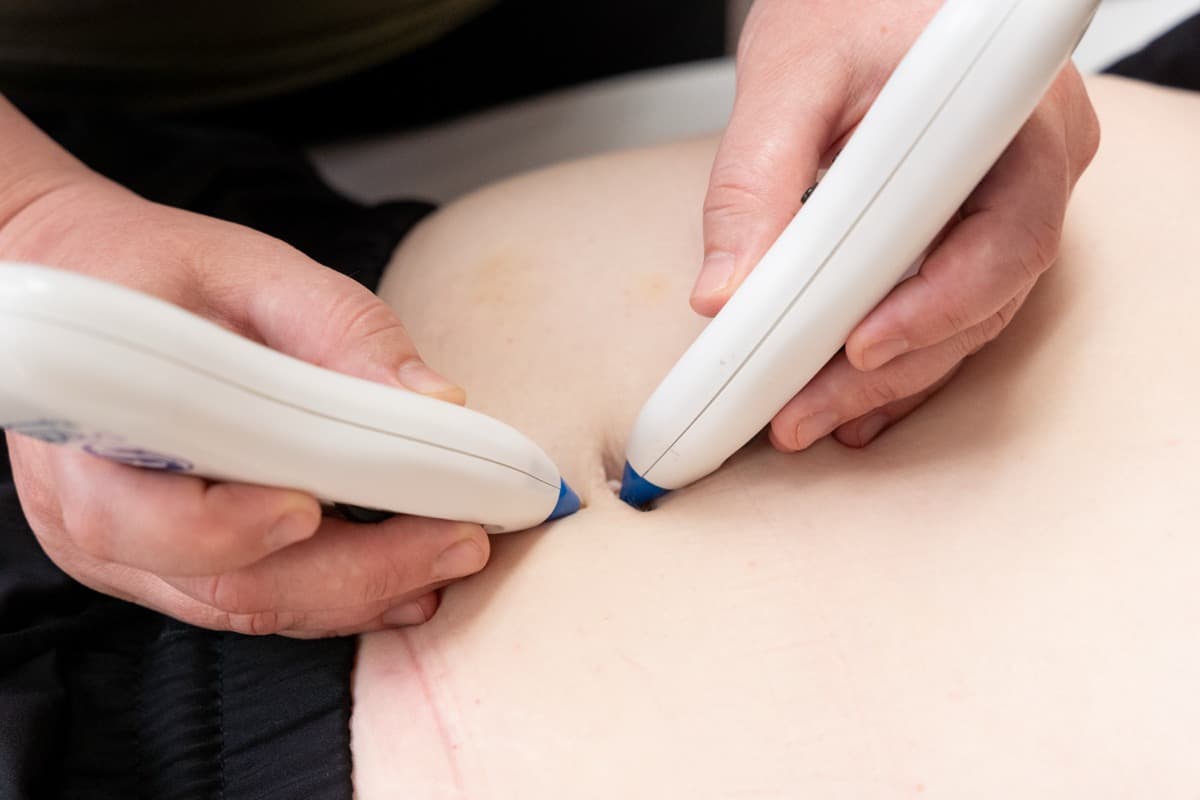
Old injuries, surgeries, and repeated micro-traumas leave behind scar tissue and adhesions that can entrap nerves and restrict the fascial glide they need to function. Dolphin neurostim and focused myofascial work help support the breakdown of those adhesions so the surrounding tissue can soften and reorganize. Learn about scar-tissue and Dolphin work →
Restoring Fascial Glide
Across all of our work, one of the underlying goals is restoring proper glide between tissue layers. Nerves are designed to slide through their surroundings as you move — when fascia gets thickened, dehydrated, or scarred, that glide is lost and the nerve gets dragged with every motion. Berry Method principles, lymphatic work, and targeted myofascial techniques all support that glide returning.
The pattern across every one of these techniques is the same: we don't force your body to do anything. We remove the obstacles and create the conditions, and your body takes it from there.
Our Approach at The Body Clinic
When you come to us with nerve symptoms, we don't just ask "where does it hurt?" We ask "where is the nerve traveling, and where along that path is the soft tissue or structural pattern keeping it compressed?"
A typical first session looks like this:
- Intake and assessment. We talk through your symptoms, what triggers them, what helps, and any medical workup you've already had. We look at your posture, range of motion, and movement patterns — often the impingement is being driven by something quite far from where you feel the symptom.
- A layered approach. For most nerve patterns, we combine several modalities: deep tissue and trigger-point work to support release of the directly compressing muscles, Berry Method for structural displacements, lymphatic drainage to support inflammation reduction, and Dolphin neurostim depending on what we find.
- The session itself. Targeted, not just general relaxation work. We're identifying the specific pattern compressing your nerve and methodically supporting your body in letting it go.
- Self-care guidance. Stretches, posture cues, and activity modifications you can do between sessions to help the work hold.
When You Should See a Doctor First
We are licensed massage therapists, not physicians. Massage is a powerful supportive tool, but it's not the right first stop for everything. Please see a doctor before booking with us if you're experiencing:
- Sudden, severe nerve pain after a fall or accident
- Loss of bowel or bladder control
- Significant or progressive weakness in a limb
- Numbness in the saddle area (inner thighs, groin, genitals) — this can be a medical emergency
- Symptoms following recent surgery, especially of the spine
- Fever, unexplained weight loss, or other systemic signs alongside the nerve pain
Your Body Already Knows How to Heal
Nerve pain is exhausting. It interrupts your sleep, your work, your patience with the people you love. And the longer it goes on, the more your nervous system learns to be stuck in that pattern.
The work we do — supporting the release of tight muscles, restoring fascial glide, repositioning structures, encouraging lymphatic flow, and calming sensitized nerves — gives your body the conditions it needs to heal itself. We're not the healer. We help create the alignment and the space, and your body — which has been doing this kind of repair work since before you were born — handles the rest.
If you've been pushing through tingling, burning, numbness, or radiating pain — or if you've tried other approaches and nothing's stuck — let's talk.
Ready to give your nerves some breathing room? Book an appointment at The Body Clinic, or call us at (801) 896-7211. Mention that you're dealing with nerve symptoms when you book, and we'll make sure you're paired with the right therapist and the right combination of techniques for your situation.
---
The Body Clinic offers therapeutic massage, the Berry Method, manual lymphatic drainage, and Dolphin neurostim work to support clients with nerve impingements, sciatica, carpal tunnel, thoracic outlet syndrome, and chronic pain at our South Ogden and Taylor, Utah locations. View all services or learn more about our team.